The Reading Layer
Jaydev Gusani
Not a redesign.
A conditional reading layer
that expands when content demands it.
The Mismatch
the current state of AI interfaces
on one side
we have hyperscale
trillions of dollars of infrastructure.
models that can reason synthesize simulate thinking across domains.
on the other side
we interact with it
through something that looks like a chat app.
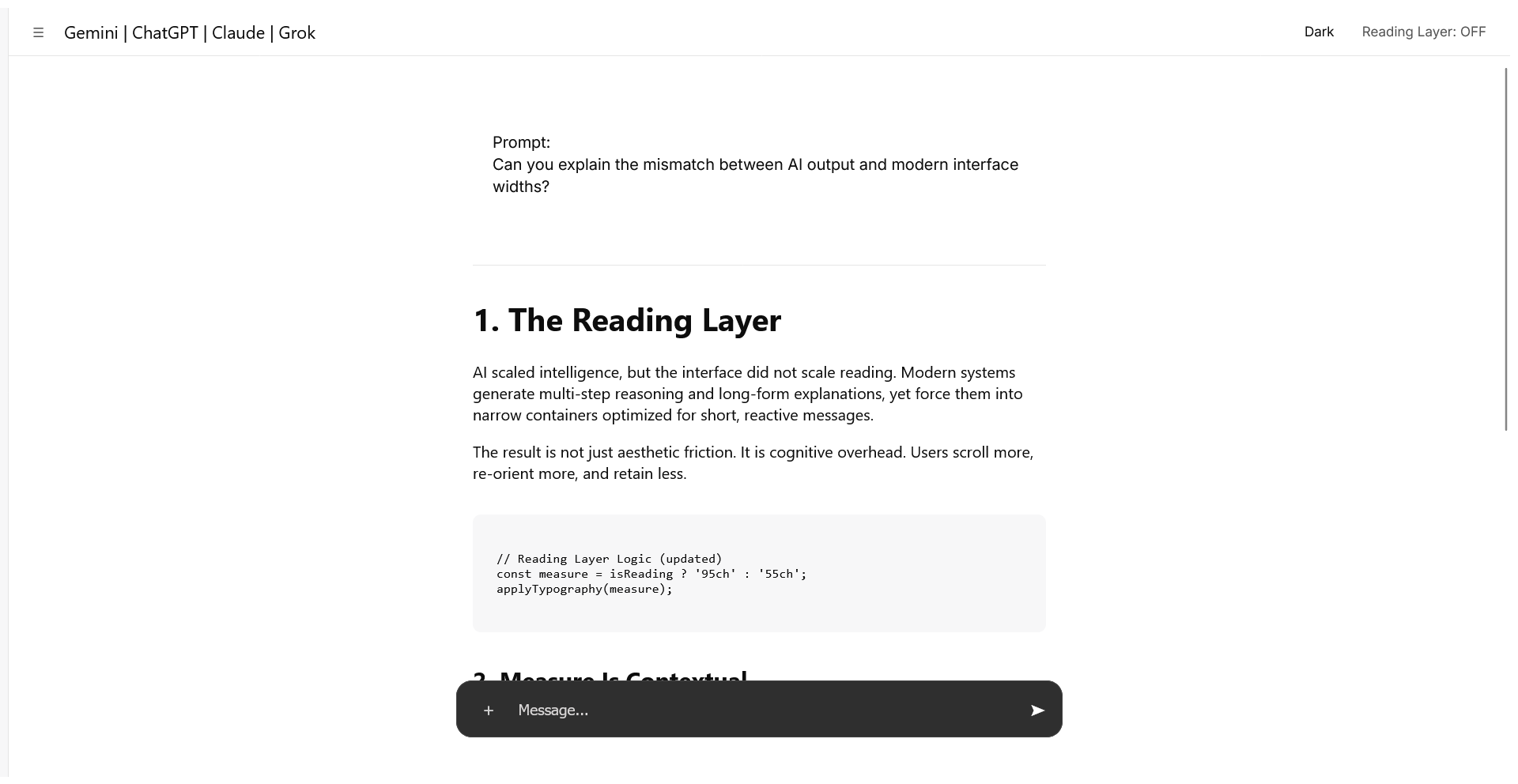
a narrow column,
short bubbles,
endless scrolling.
the interface did not
The Cost
this is not a capability problem
it is a friction problem
when intelligence exceeds its container
the user absorbs the cost
You feel it as fatigue
too much vertical scrolling
no sense of structure.
everything flattened into one stream nothing anchors your attention
you are not reading
you are navigating and slowly losing context
The system forgets nothing.
The user cannot find it.
The Separation
chat is not reading
they look similar
they are not
chat is reactive
fast
disposable
reading is slow
structured,
cumulative.
we built for the first
we are now using it for the second
that is the mistake
The System
the interface should not guess
it should decide
before the first token appears
the system already knows
this will be short
or this will require attention
if it is dense
if it is long
the interface changes state
not visually
structurally
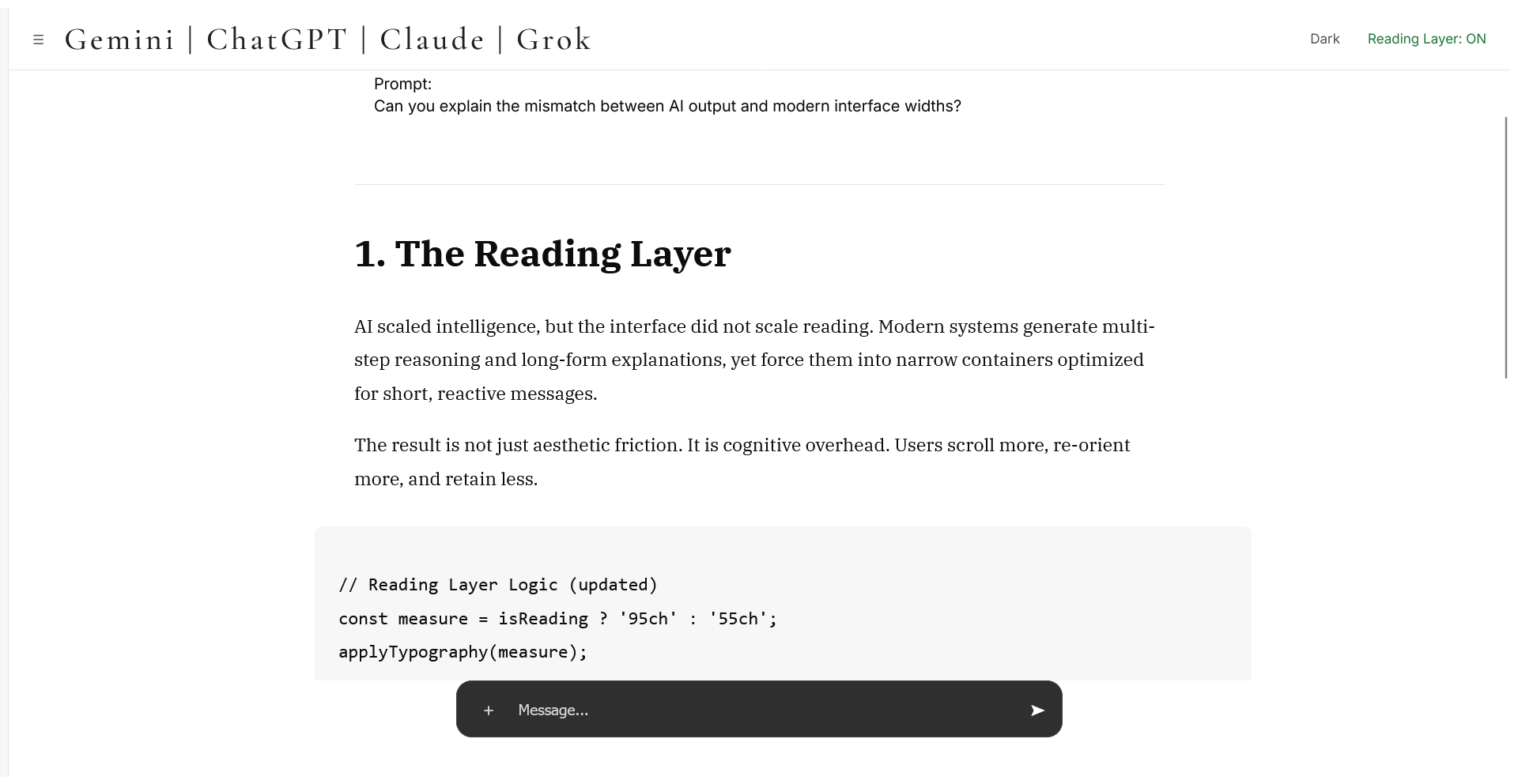
the layout expands,
the typography shifts,
the page stabilizes
then the content arrives
not into a chat bubble
into a space designed to be read.
The Variables
this is not decoration
it is constraint
line length increases
text breathes
typography shifts from functional
to readable
spacing slows the eye down
code escapes the container
instead of being crushed by it
hierarchy becomes visible
the content stops being a wall
and becomes a map.
The Implementation
this is not heavy
no new pipeline
no new model
a conditional layer
a single decision
applied early
the interface adapts
before the user notices
and then it disappears
because it is doing its job.
The Experiment
same content different surfaces
ChatGPT
the most widely deployed reasoning system on the planet.
hundreds of millions of users.
still rendered in a narrow column with a text box at the bottom.
it reads like a settings menu.
not a document.
Gemini
google's entire infrastructure behind it.
tpu pods, search integration, multimodal reasoning.
wide sidebars, centered bubbles
half the screen surrendered to emptiness.
the most data-rich AI system ever built.
compressed into a chat window.
Grok / Project Colossus
infrastructure approaching multi-gigawatt scale.
hundreds of thousands of GPUs.
systems built for continuous, real-time reasoning.
still rendered in a chat interface.
the scale expanded.
the interface did not.
Claude
closer
it understands something subtle
interaction and reading
are not the same
but it hesitates
it almost commits
to a reading-first interface
then pulls back
The Outcome
when the interface gets out of the way
people read differently
they slow down
they retain more
they notice errors
because structure reveals.
the system feels less like a tool
more like a place.
Not a terminal
A Library
The Position
We scaled
intelligence
We did not scale
comprehension
it is in the interface.
the cost to fix it is trivial
the cost of ignoring is not.
every session that ends before understanding happens
the reading layer is not a featureit is the missing piece
between thinking machines and thinking users
Comprehension alone does not complete the interface.
To read is one layer.
To return is another.
A reading layer solves display.
A memory layer solves retrieval.
Both belong to the same unfinished architecture.
companion system
The Prompt Journal
extends this argument into retrieval.